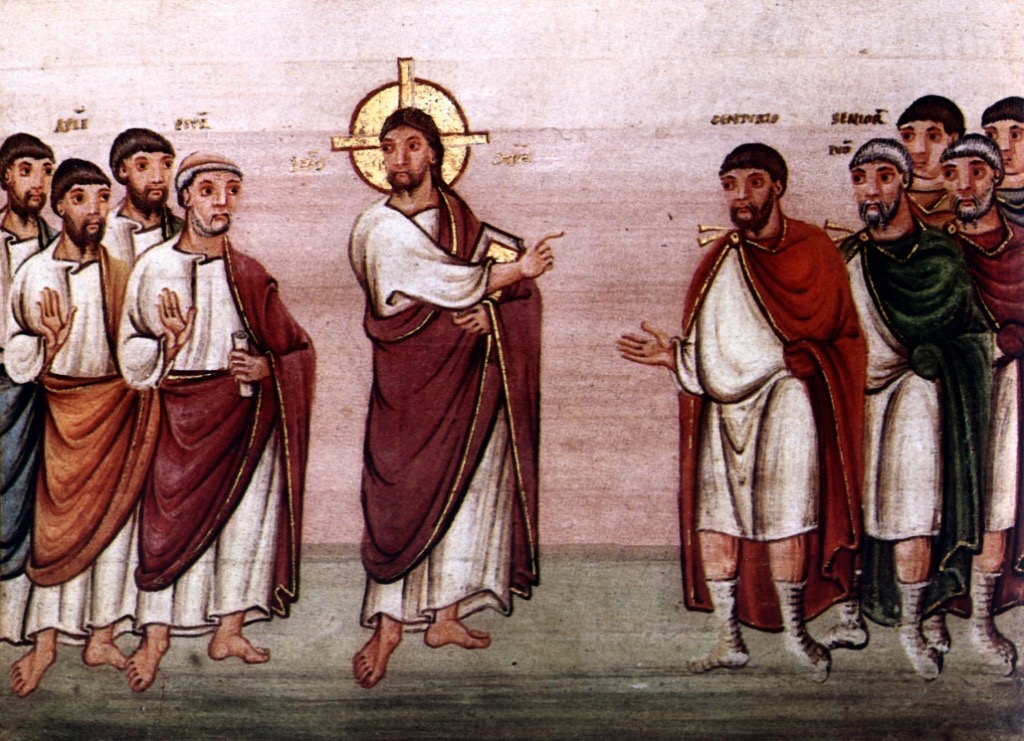
From Fig Tree to Martyrdom

From fig tree to martyrdom, Bartholomew’s life is a testimony that the power of faith rests not in us, but in Christ who calls and keeps us.

Saint Bartholomew—also called Nathanael in John’s Gospel—shows us what it means to be seen and known by Christ. At first he was skeptical when his brother Philip told him about Jesus. But when Jesus revealed that He already knew him, Bartholomew confessed with bold faith: “You are the Son of God! You are the King of Israel!”

That same pattern holds true for us. Left to ourselves, we remain under the shadow of sin and death. But when Christ calls us by His Word, when He joins us to Himself in Baptism and feeds us at His table, we are brought from shadow to light, from doubt to confession, from death to life. Like Bartholomew, we find that our faith does not rest on our own strength but on Christ who first knows us.

Tradition tells us Bartholomew carried the Gospel as far as India and Armenia, where he sealed his witness with his blood. He was not remembered for seeking his own greatness but for pointing always to the greatness of Jesus. His life and death remind us that the treasure we carry is Christ Himself, and that even in our weakness the Gospel is the power of God for salvation.

May God grant us, as we pray in the Collect for this day, to love what Bartholomew believed and to proclaim what he taught: that Jesus is the Christ, the Son of God, who still comes among us as the One who serves.

Listen to the entire sermon:

Christ, the Faithful Steward

Yesterday, we heard Christ’s teaching from Luke 16 about stewardship and how Jesus shows us what true stewardship looks like. The Father entrusted Him with everything—including fragile human flesh and blood—and He spent it all for you. Every step of His life, every word He spoke, every drop of His blood was given so that you might be forgiven and made a child of God.

That changes how we see our own lives. What we have—our time, our abilities, our possessions—isn’t really ours. They’re gifts from God, placed into our hands for the sake of others. Earthly things won’t last, but when they’re spent to share Christ’s love and His Gospel, God uses them for something eternal.

So take heart. Your salvation doesn’t rest on how well you manage what you’ve been given—it rests on Jesus, who has already secured it all for you. And now, with joy and freedom, you can use His gifts to point others to the one treasure that never fades: Christ Himself, who is your peace and your home forever.

Listen to the sermon:

Earthly & Heavenly Bread – A Homily on Mark 8:1-9

On the Seventh Sunday after Trinity (Aug. 3), Father Leigeber preached on Christ’s miraculous feeding of the four thousand (Mark 8:1–9), reminding us that God alone provides our daily bread—both for this life and for the life to come.

The multitude in the Gospel lesson left everything behind to hear Jesus’ Word, going without food for three days. Their hunger for the Word of God outweighed their bodily needs—a striking example of the truth that “man does not live by bread alone, but by every word that proceeds from the mouth of God.”

Jesus, seeing their need, feeds them miraculously with seven loaves of bread and a few small fish—showing that God is the giver of all things, physical and spiritual. Father Leigeber reminded us that our meals, our homes, our families—everything—are gracious gifts from our heavenly Father. This is why Christians pause to pray before meals, following the example of Christ Himself.

Yet the feeding miracle points beyond mere daily sustenance. The language of taking, blessing, breaking, and giving the bread to the disciples draws our attention to the Holy Eucharist, where Christ feeds His Church with His very Body and Blood. Just as He used the disciples to distribute bread to the people, so today He uses pastors to deliver His heavenly gifts in Word and Sacrament.

In a world of busyness and distraction, we are tempted to neglect this miraculous Meal. But Jesus’ compassion remains. Even if we’ve been forgetful or careless, He still offers Himself to us. Every Sunday, Christ performs a miracle—nourishing and sustaining His people with the Bread of Life, for the strengthening of faith and the hope of resurrection.

Let us never forget the Source of all good things. And let us give thanks, both at our tables and at His altar: “O give thanks unto the Lord, for He is good, and His mercy endures forever.”

Listen to the entire sermon: